
Lehigh University recently welcomed a delegation from Almaty Management University (AlmaU), a leading higher education institution in Almaty, Kazakhstan, for a three-day visit to advance a new phase of collaboration between the two universities.
The AlmaU delegation included Dr. Sholpan Tazabek, vice-rector for global partnerships; Arman Komekbayev, dean of the School of Digital Technologies and Economics; Dr. Zhaniya Khaibullina, director of the Sustainable Development Center; and Dr. Meruyert Seidumanova, research assistant professor in the School of Transformative Humanities.
Building on AlmaU President Assylbek Kozhakhmetov’s visit to Lehigh in September 2025, the group returned with a clear objective: to further develop a new integrative academic platform at AlmaU known as the Global Impact Collaboratory (GIC).
The proposed Collaboratory is envisioned as a unifying institutional platform embedded within AlmaU’s academic structure, designed to connect coursework, applied research and community engagement. Informed in part by Lehigh’s Impact Fellowship programs, the Global Impact Collaboratory represents a different approach to international collaboration. Rather than relying on traditional exchange or branch-campus models, the initiative emphasizes shared projects, accessible participation for faculty and students, and partnerships focused on real-world impact in Central Asia.
“What stood out most to me is that Lehigh feels deeply intentional,” said Dr. Tazabek. “There is a strong culture of learning by doing. You can see it in conversations with students and faculty. That philosophy aligns with what we are building at AlmaU.”
The growing partnership is already visible through student engagement. In May 2026, the largest cohort of approximately 30 Lehigh Global Social Impact Fellows will travel to Almaty for fieldwork—the fifth GSIF cohort to conduct fieldwork in Kazakhstan.
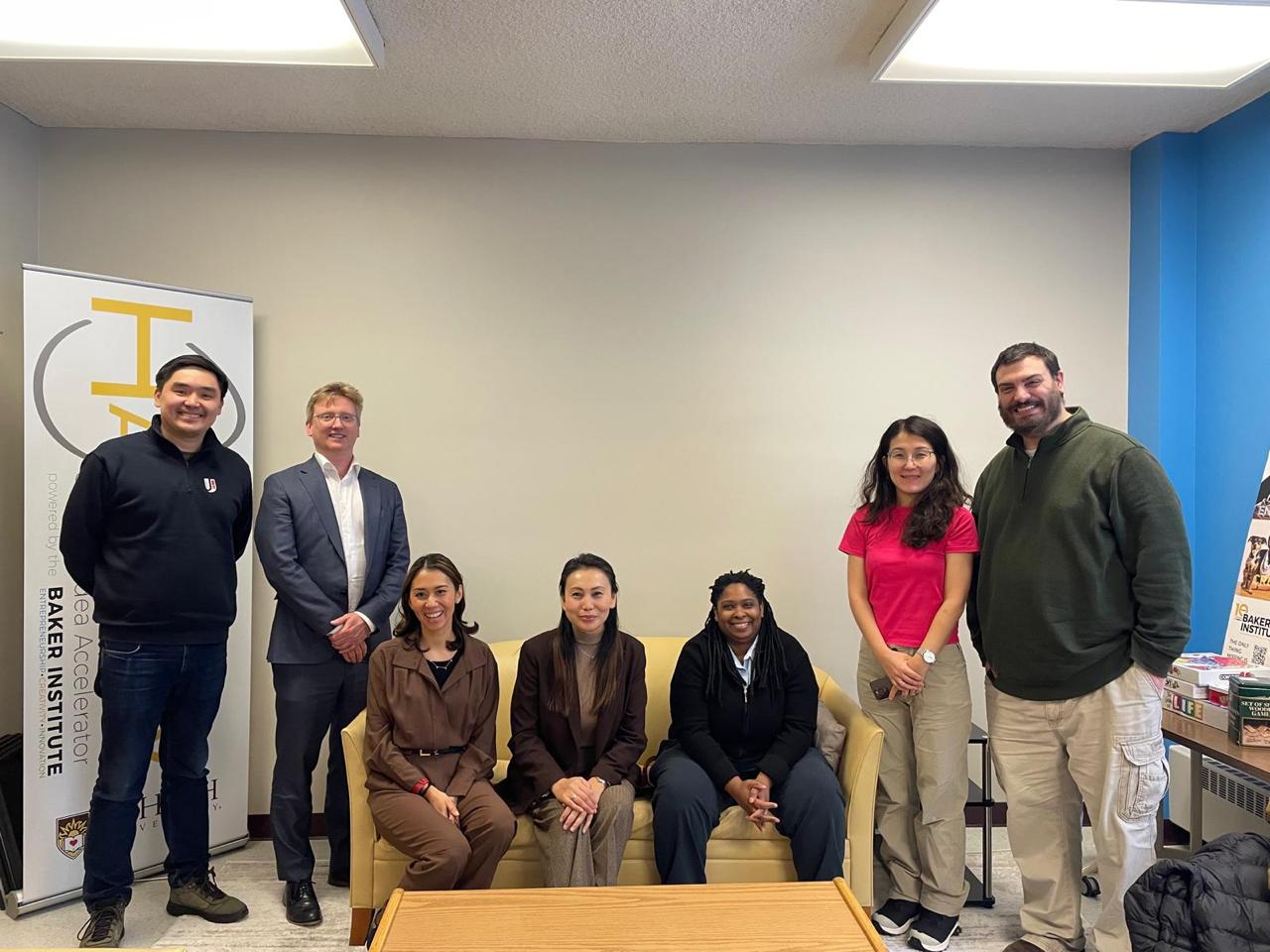
During the visit, AlmaU leaders engaged with Impact Fellows and faculty mentors representing all six Global Impact Fellowship Kazakhstan project teams. The conversations highlighted how these student-led initiatives integrate societal impact, research and entrepreneurship to address regional challenges.
The delegation sat down with the Swello and TremorTrack teams, mentored by Assistant Professor of Bioengineering Dhruv Seshadri. Students shared progress on wearable health technologies focused on neurological monitoring and rehabilitation, demonstrating translational research connected to clinical and community partners in Kazakhstan.
For Jacob ten Bosch ’27, a bioengineering major and member of the Swello team, the discussion reflected the momentum of a deepening collaboration.
“The Swello team met with AlmaU delegates to discuss our long-term venture to develop a wearable device that monitors vital signals associated with dysphagia rehabilitation,” he said. While the technology has advanced, bringing it into clinical settings requires a deeper understanding of Kazakhstan’s healthcare and economic landscape. Collaboration with AlmaU students, particularly in business and finance, is helping bridge that gap.
The visit also included conversations with 2025 and 2026 Global Social Impact Fellowship students working on Kazakhstan-based projects, underscoring how interdisciplinary teams move ideas from research to implementation in partnership with local stakeholders.
A central component of the proposed Global Impact Collaboratory is the development of a makerspace designed to serve as an engine for entrepreneurship, educational innovation and democratized design. During their time on campus, the AlmaU delegation toured Lehigh’s Design Labs to see how a strong culture of creativity and a growing innovation ecosystem support hands-on learning.
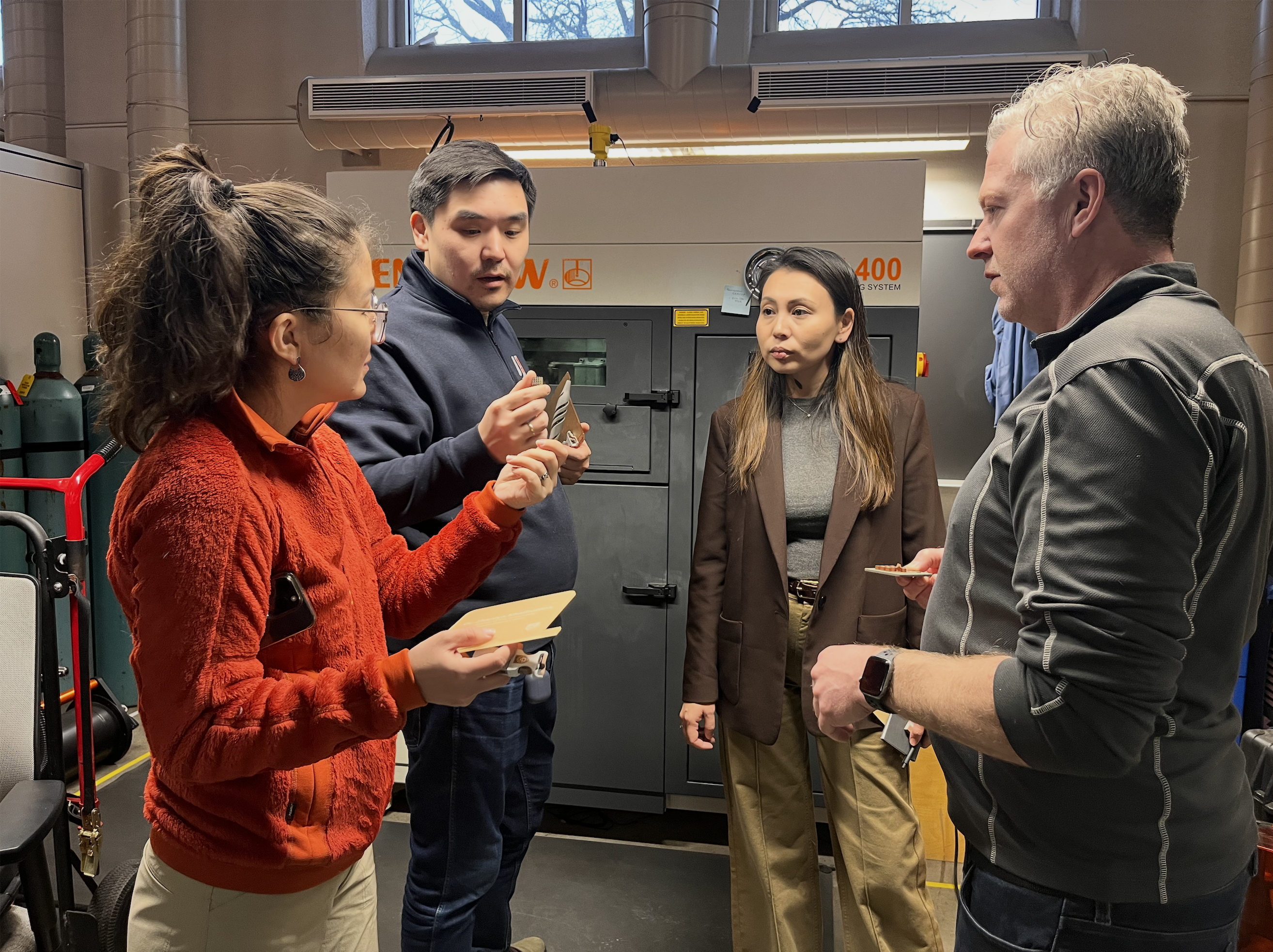
Faculty and staff demonstrated how students move ideas from sketches to functional prototypes, using maker infrastructure to test and refine solutions. The delegation also participated in a hands-on design exercise, soldering a lighted award stand and experiencing firsthand the making-centered approach that connects technical skills with venture development and community impact. The visit highlighted how resources such as the Baker Institute and campus entrepreneurship initiatives contribute to a broader creative economy.
Beyond the maker spaces, leaders from both institutions discussed how the Collaboratory model could be adapted to AlmaU’s context and implemented in phases. The long-term objective is to advance AlmaU as an impact-driven university that integrates learning, research and engagement into a cohesive framework with measurable outcomes.
Translating that vision into practice required in-depth conversations across Lehigh’s academic and innovation leadership.
The AlmaU delegation held discussions with Stephen P. DeWeerth, Lew and Sherry Hay Dean of the P.C. Rossin College of Engineering and Applied Science, on interdisciplinary research and engineering education. Strategic conversations continued with Vice Provost for Entrepreneurship Lisa Getzler; Director of the Baker Institute Michelle Julet; Vice Provost for Educational Innovation and Assessment and Senior Advisor to the Vice Provost for Research Dominic Packer; and Vice Provost for Library and Technology Services Greg Reihman, focusing on how institutional structures support innovation, venture creation and evidence-based educational design.
Additional meetings connected the AlmaU leaders with the Lehigh West team to explore innovation partnerships, with Dinissa Duvanova, professor and chair of international relations, to discuss global policy and Central Asian affairs, and with the Lee Iacocca Institute for Global Leadership to examine how leadership training could strengthen the Engage and Lead stage of the proposed student pathway.
A strategy session advanced planning for the Humanitarian Design and Social Entrepreneurship Leadership Intensive, scheduled to launch in Almaty in May 2026. The program will bring together Lehigh’s Sustainable Futures Fellows with students from AlmaU and other Kazakh universities in a collaborative environment that combines leadership development with applied project work, serving as an early implementation step for the Collaboratory model.
“This partnership is about preparing the next generation of Future Makers,” said Vice Provost for Creative Inquiry Khanjan Mehta. “We are co-designing an ecosystem that empowers students in Kazakhstan and at Lehigh to move from learning to leadership, from ideas to execution, and to create meaningful impact in their communities and beyond.”


