
2027 Impact Fellowship Applications
Priority deadline: November 2nd - Applications accepted until all spots are filled
Want to review the questions before applying? Preview the application form in PDF format to prepare your responses before completing the online application.
Please note: The PDF is for reference only. Applications must be submitted through the online form.


Program Overview
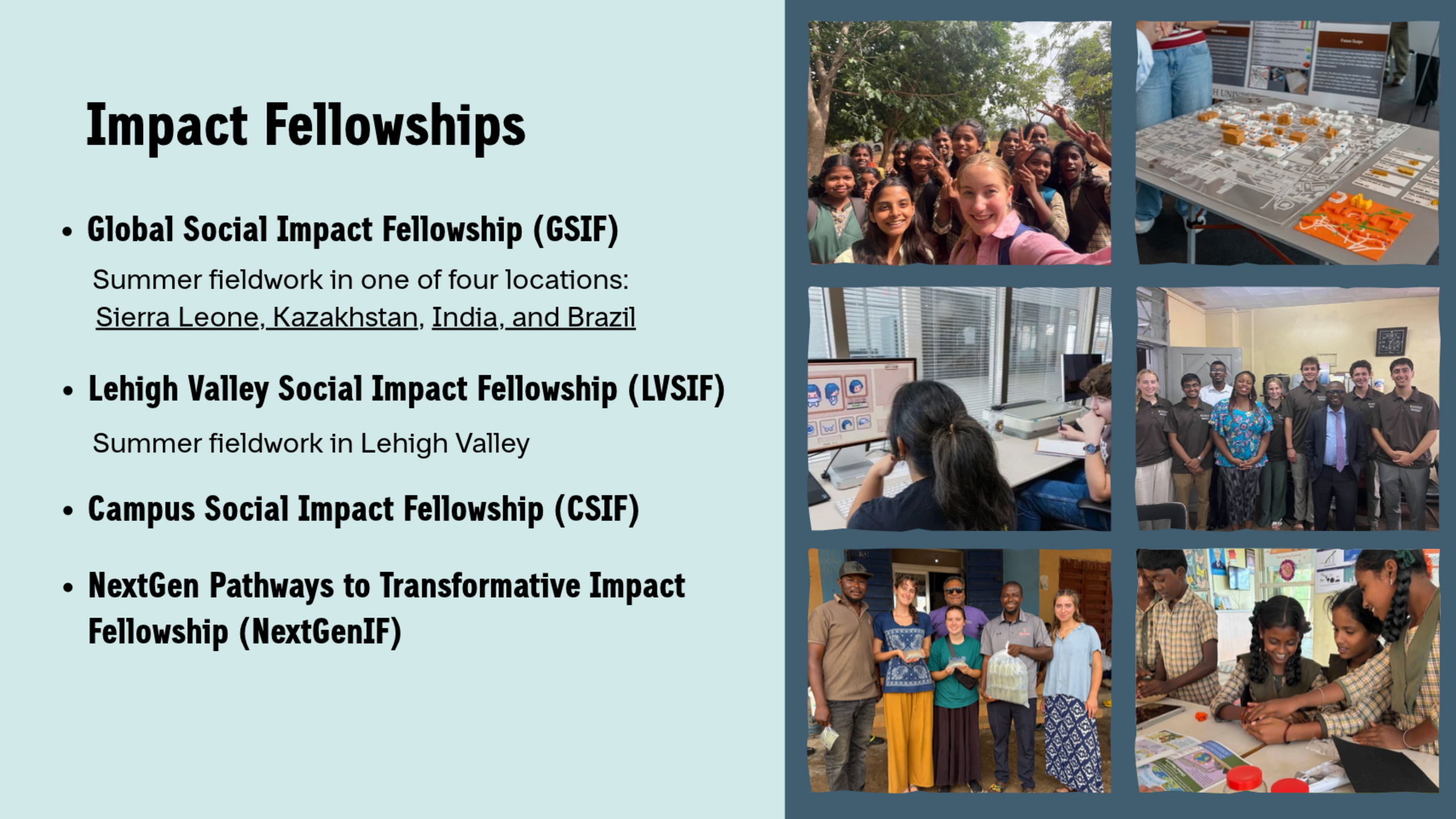
Impact Fellows are a highly self-selected cohort of students from all disciplines across Lehigh University, focused on addressing sustainable development challenges in low-resource and middle-income countries and communities across the world. IFs advance multi-year projects in the Spring and Fall semesters (total six academic credits) and engage in faculty-guided fieldwork with diverse local partners during the Summer. The courses, workshops, retreats, and immersive experiences of this program integrate experiential learning, research, and entrepreneurial engagement with students leading original and ambitious projects with partners in diverse localities. Select IFs will have the opportunity to participate in the Mountaintop summer program to advance their projects.
Through engaging in such meaningful, authentic, and incredibly alive projects, Impact Fellows develop skillsets, mindsets, and portfolios to solve complex societal challenges. Fellows build sustainable enterprises, publish their works in peer-reviewed journals, integrate their insights into national and regional policies, and champion movements that influence the lives of millions of people. The quest for sustainable impact drives the philosophy, pedagogy, and operations of this program with the objective of preparing students to lead lives of impact.
What’s In It for Students?
- An opportunity to work collaboratively with the most driven students and world-class faculty mentors from across the university on ambitious multi-year projects that strive to deliver social impact.
- Work across disciplines, cultures, language and time barriers to co-create practical, innovative, and sustainable solutions with partners - through virtual teaming, in-person meetings, and on-the-ground fieldwork.
- Engage in fieldwork with faculty mentors who have decades of experience conducting research, designing solutions, and building systems in low-resource countries and communities.
- Conduct original research and get your work published in journals and conference proceedings. Travel to conferences to present your work and build your professional network.
- Enhance your human skills and build life-long friendships with peers at Lehigh and with some amazing people in the localities where we work.
- Distinguish yourself and become more competitive for prestigious fellowships and awards, graduate / professional schools, or that dream career pathway.
- Impact! Conducting research and jumpstarting social enterprises is incredibly difficult but also deeply rewarding.
Current Impact Fellowship Projects
- Sierra Leone: CareAlert - Timely Reminders, Timely Care
- Sierra Leone: AISHA - Artificial Intelligence Strengthening Healthcare Access
- Sierra Leone: SicklED - A Low-Cost Point-of-Care Screening Platform for Sickle Cell Disease
- Sierra Leone: Newtrition - Fortified Food Development and Commercialization with Local Businesses
- Sierra Leone: Stories That Shape Us - Understanding the Influence of Media on Love, Marriage, and Family Formation
- Sierra Leone: PAPER - Panels for Adaptive Public-health Education and Response
- Brazil: PlasTech Ventures - From Sachet to Solutions , Turning Trash into Treasures
- Brazil: AgriWrap - Converting Food Waste into Biodegradable Packaging Products
- Brazil: TrackTB - Transforming TB Treatment Through Patient-Centered Digital Health Solutions
- Brazil: Smartphone-Based Cardiorespiratory Monitoring for Underserved Communities
- Brazil: Developing a low-cost AI-based multimodal cardiorespiratory monitor
- India: Future Makers Unlimited - Integrating Making and Design Thinking into India’s Curriculum
- India: Climate Heroes - Science Kits for Empowering Climate Change Solutions
- India: RAISE - Responsible Use of Generative AI in K-12 STEAM Education
- India: Cultivating the 4 Cs - School Leadership in the Age of AI and Experiential Learning
- India: From Bytes to Brilliance - Transforming Learning through Digital Ingenuity
- India: Agastya Quest - Wonder. Wander. Discover.
- Kazakhstan: PureSpaces - Transforming Indoor Air Quality for Health
- Kazakhstan: Save Tuba - Gamifying Sustainability Education for Kazakhstan's Youngest Learners
- Kazakhstan: Fertile Futures - Converting Industrial Waste Gypsum into High-Value Slow-Release Fertilizers for Agricultural Resilience
- Kazakhstan: Global Impact Collaboratory (GIC) - Building Bridges Across Central Asia
- Kazakhstan: TremorTrack - MIcrotremor Detection Device for Early Diagnosis of Neurological Disorders
- Kazakhstan: AgriMed - Taking the Thinking out of Swallowing for Patients with Dysphagia
- Data Centers in the Lehigh Valley - Powering Community Change
- Fostering New Futures - Connecting Transitional-Age Foster Youth with Mentorship and Community
- Beyond Bars: Tell Your Own Story - Storytelling Workshops as a Restorative Practice
- ImmersED - Social-Emotional and Academic Learning through 360° Immersive Experiences
- B Beautiful: Community Mapping for Environmental Justice
- Mapping for Change: Advancing Inclusive Walkability and Accessibility Across the Lehigh Valley
- Creating an Accessibility Index for Cities
- Lehigh Valley Food Connect
- Mapping the Heritage Landscape of the Lehigh Valley
- Community-Engaged Urban Greening for Public Health
- Southside Brain Health - the NeuroArts Initiative
- ImpactTrails - Helping Students Find Their Why
- Leveling Up to Lehigh Life - Using Video Games to Decrease Anxiety during the Transition to College
- Lehigh FORGE - Build the Festival. Forge the Culture.
- Mindful Steps into the Forest - Expanding Accessible Nature Engagement Across Real and Virtual Environments
- From Weathercasts to Healthcasts - A Campus Framework for Influenza Communication
- Agent Asa
- Student Senate: Civic Engagement, Campus Impact
- Mapping the Roots of Radical Beliefs - Understanding the development of extremism in adolescents and young adults
- Exploring Active Granular Media
- STEM Visualizations - Promoting Experiential Learning through Interactive Online Visualizations
- Childhood - Environment, Emotions, and Social Engagement
- An Integrative Approach to Studying Adolescents' Online and Offline Social Lives
- How to Succeed in Symbiosis
- Behavior-Adaptive Epidemic Digital Twin for Community Health Resilience
- Self-Driving Cars in Urban Environments with Traffic
- AI-Enabled Humanoid / Quadruped Robot Perception and Control
- What lets a comb jelly take over a new sea?
- BioPaint: Skin-Conformal Electrodes for Continuous Health Monitoring
- DropletRunner - a Robotic Platform for Autonomous Liquid Navigation
Frequently Asked Questions
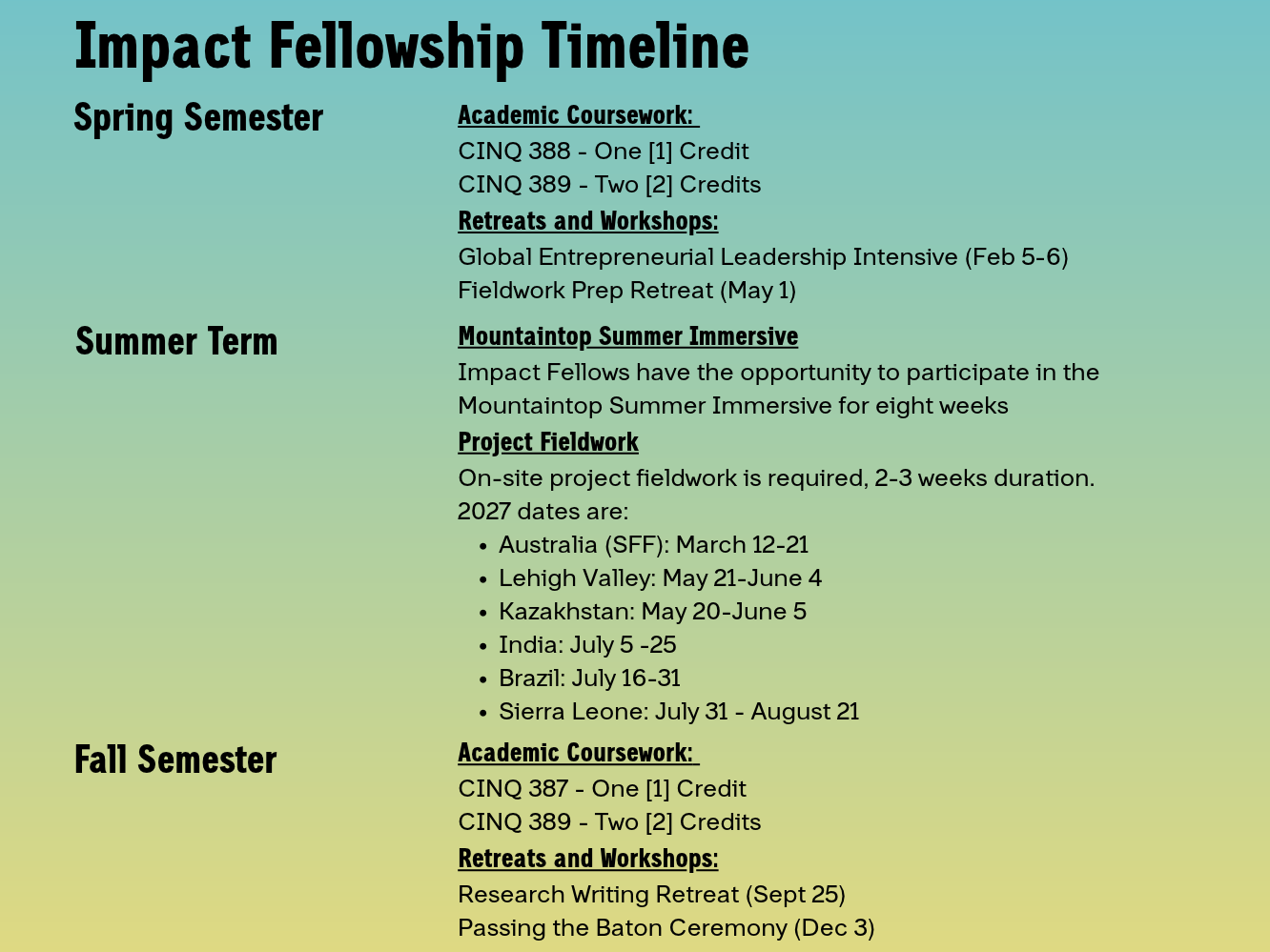
This is the common, weekly, one-credit class required for all Impact Fellows.
- If you are in the NextGen Impact Fellowship, the class meets on Tuesdays from 3:00-4:15pm during the Spring and Fall semesters.
- If you are in the other Impact Fellowships (Global, Lehigh Valley, Campus), the class meets on Tuesdays from 7:15-9:55pm during the Spring and Fall semesters.
Regular attendance at this class is required. The class is a hands-on workshop course, where you will work with your team and other IFs to apply a set of concepts and topics - business models, value propositions, creating partnerships, funding, ethical decision-making, etc. There is a weekly blog assigned as part of this course, but most of the time you will work on, or at least start, that blog during class. Some blogs are individually written, others are team-written.
CINQ 388 is taken in the Spring semester, and CINQ 387 is taken in the Fall semester. Same course, different semesters.
CINQ 389 is the project-based course - IFs receive credit for working on the project with your team and faculty mentor/s. Each team sets a weekly meeting time when all students and faculty mentors can attend, throughout the semesters. Those meetings are an opportunity to sync up, determine progress and goals, and discuss tasks at hand and are required of all teams. Other than that weekly meeting, there is not a meeting time for CINQ 389 - it is independent (or team-based) project work.
No. CINQ 388/387 classes are different for NextGen and other IFs, so those two sections are not interchangeable. CINQ 389 has a section of the course for each specific project, so you must enroll in the correct section.
For all Global and Lehigh Valley Social Impact Fellows, yes.
All GSIFs and LVSIFs who have a 'B' grade or better in the CINQ courses during the Spring semester can conduct fieldwork. The Office of Creative Inquiry covers all major on-the-ground expenses for fieldwork - accommodations, most meals (minimum breakfast and dinner daily), local transportation, project-related expenses, etc. Students may wish to have some personal money for lunches, souvenirs, and other minor needs.
IFs are responsible for the cost of their airfare, necessary vaccinations (if needed), visas (if needed), and transportation to/from U.S. airports. Students with financial need will be prioritized for funds that may be available through colleges, departments, and other campus offices. The Office of Creative Inquiry will also prioritize additional funding support for students with high financial need. The Student Opportunity Fund is a resource that can cover U.S. expenses only (such as obtaining vaccinations for Sierra Leone in advance of fieldwork).
Our commitment is that, although this is not a fully-funded program, students with financial need will not be prohibited from participating in fieldwork for reasons of lacking the funds. We will work with you to find the appropriate funding support.
Airfare to Almaty, Kazakhstan, round-trip, is typically less than $1,300.
Airfare to Manila, Philippines, round-trip, is typically less than $1,800.
Airfare to Sierra Leone, round-trip, is typically less than $1,500.
Airfare to Bangalore, India, round-trip, is typically less than $1,200.
Required vaccinations can cost upwards of $400, sometimes less. Visas can cost $80-100 depending on the student's country of passport and which country they are entering.
Lehigh Valley fieldwork should not involve significant out-of-pocket cost. The program will cover dorm fees and meal plans.
YES. All travelers to Sierra Leone, with a few exceptions such as East African countries, must have a visa. U.S. travelers need $80 (cash, new bills, $20s) upon arrival in country to obtain a visa for entry. The program does not cover this cost by default.
Sierra Leone also requires yellow fever vaccine, which must be obtained or the traveler will not be able to enter the country. Yellow fever vaccination can be given once and be valid for life. GSIF Sierra Leone students should make arrangements to receive this vaccine as early as possible to avoid any lack of available appointments closer to fieldwork dates. The yellow fever vaccine on its own typically costs around $250. No other vaccinations are required.
CINQ 389 is a variable-credit course, although Impact Fellows are required to take the course for two (2) credits in both the Spring and Fall semesters.
Since it a variable-credit course, the default number of credits when you enroll is one (1). To change it, you must follow a simple process that is outlined here: https://youtu.be/x88P_4b0oxE?si=eePC0JIAhWZkN6zg.