
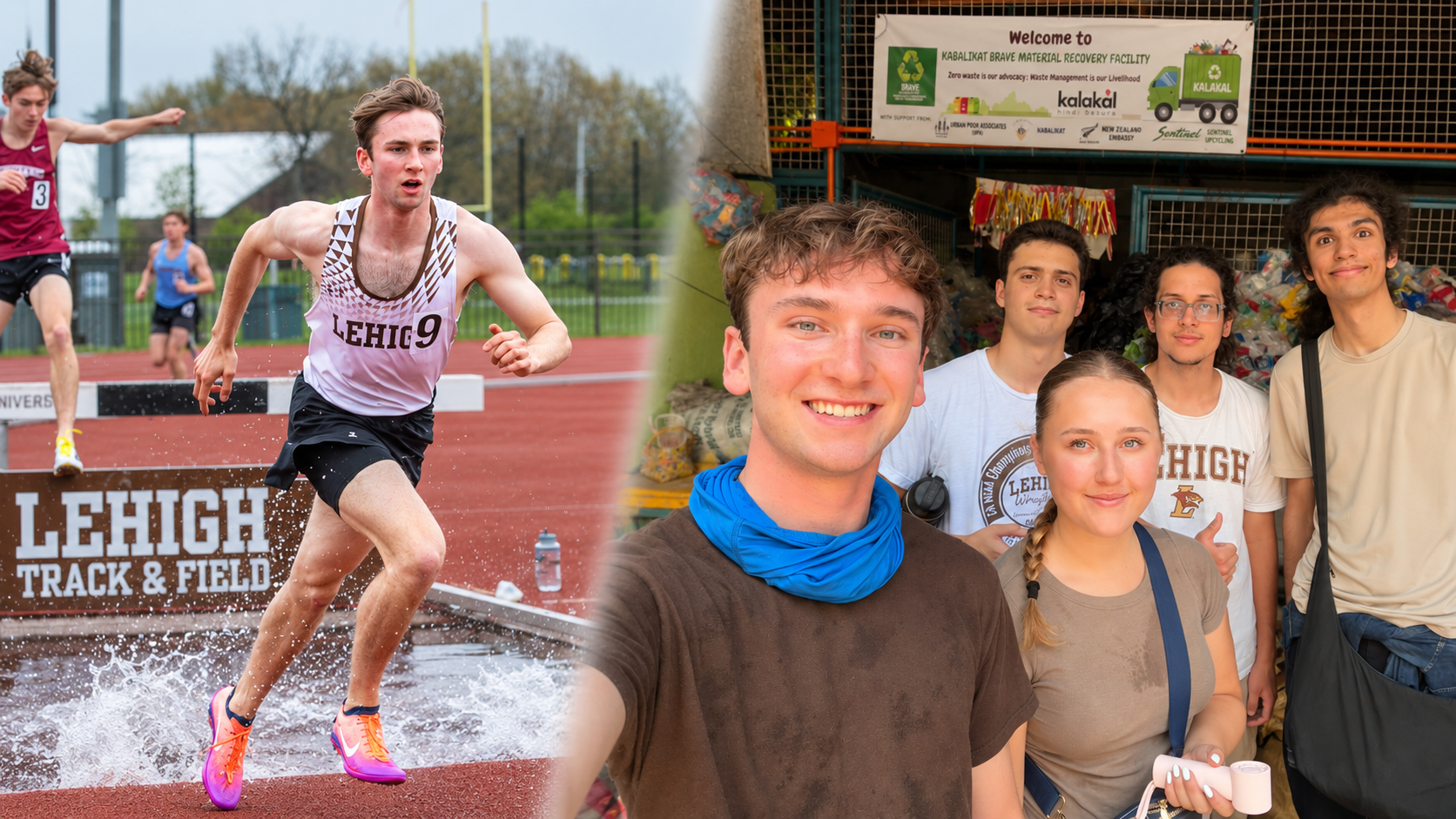
Beyond the Games: Student-Athletes Making an Impact
Lehigh student-athletes balance Division I competition with research, project work and fieldwork around the world through the Impact Fellowship program.
Can a Division I student-athlete train year-round, take on ambitious research and also travel for fieldwork around the world?
For a group of Lehigh student-athletes participating in the Impact Fellowship program, the answer is yes.
It takes careful planning, communication and some very full days, but the students say athletics and high-impact academic experiences often reinforce one another in unexpected ways.
Impact Fellows spend two semesters advancing interdisciplinary, real-world projects alongside faculty mentors and teammates. For Global Social Impact Fellows, that work also includes summer fieldwork with partners around the world.
“At Lehigh, we want student-athletes to have a rigorous and meaningful experience both in competition and in the classroom,” said Jeremy Gibson, Murray H. Goodman Dean of Athletics. “Opportunities like the Impact Fellowships allow them to engage in research, real-world problem-solving and experiential learning while continuing to compete at the Division I level. That combination is an important part of the complete Lehigh student-athlete experience.”
A two-week window around the world
For Elizabeth “Libby” Ehrhardt ’28, cross country and track and field leave almost no traditional offseason.
She competes or trains through the fall, winter and spring, making a semester abroad difficult to fit into her athletic schedule. But fieldwork with SaltX, a Global Social Impact Fellowship project focused on reducing sodium consumption and improving nutritional labeling in Kazakhstan, landed in a rare opening.
“The two weeks I was in Kazakhstan was my two-week break between spring track and field and fall cross country,” Ehrhardt said.
It was also her first time outside the United States.
In Almaty, Ehrhardt and her teammates worked with local university students and stakeholders while examining public health and nutrition issues related to high sodium consumption. Their work focused on reducing sodium intake through public health education, nutrition labeling and strategies to support healthier food choices in Kazakhstan.
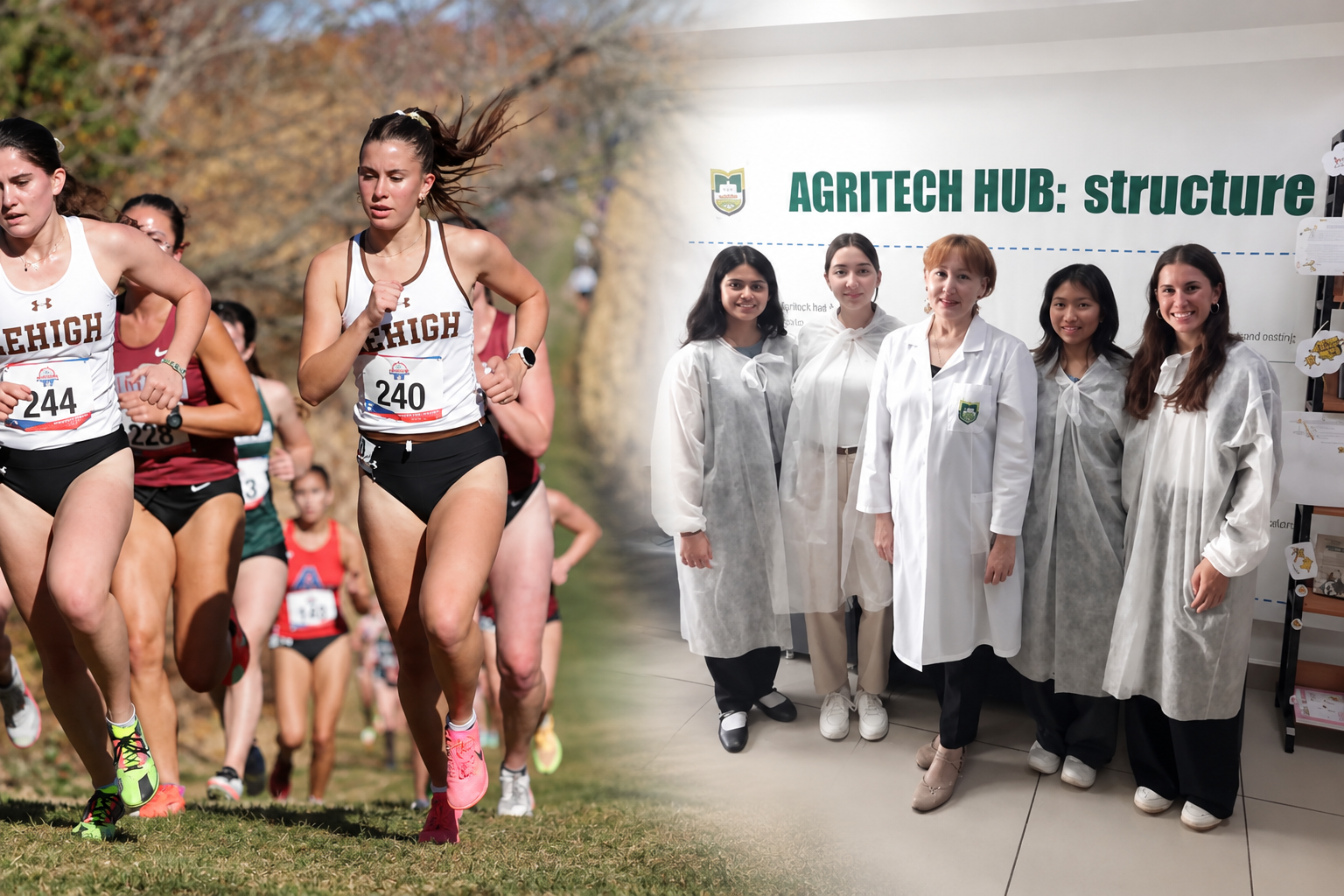
The project continued after fieldwork. Ehrhardt later co-authored two peer-reviewed articles accepted for publication in the 2025 IEEE Global Humanitarian Technology Conference proceedings: one on industrial approaches to advancing low-sodium diets in underserved communities and another on front of package labeling as a global public health tool to reduce diet-related non-communicable diseases.
Some of her most meaningful experiences happened outside formal meetings. She remembers meals with three AlmaU students close to her own age, comparing everyday life in Kazakhstan and the United States and discovering how much they shared.
“It made me feel more connected to people across cultures,” Ehrhardt said.
The experience also strengthened her interest in research and public health. She came away with a deeper understanding that effective public health work must account for a community’s lived experiences, history and priorities.
Getting there required flexibility on campus, too.
The Impact Fellowship’s weekly workshop class overlapped with one of the distance team’s primary workout days. Ehrhardt sometimes needed to leave practice early or arrive at class a few minutes late.
What made the arrangement sustainable, she said, was communication among her coaches, the program’s academic mentors, and teammates.
“Having that understanding on both sides made it less difficult than I think it could have been,” she said.
The experience made such an impression that Ehrhardt later encouraged other members of Lehigh’s track and field team to apply.
“Part of why I chose Lehigh Athletics and Lehigh academics was because I knew that I could have that balance between the two,” she said. “The Impact Fellowship really let me lean into that balance between both aspects of my life that are really important to me.”
Packing a field hockey stick for India
For Ella Stephenson ’27, an IDEAS major, the challenge came at the end of summer.
Stephenson, a senior on Lehigh’s field hockey team, traveled to India through GSIF’s RAISE project (Responsible Use of Generative AI in K-12 STEAM Education), shortly before returning to Lehigh for preseason.
RAISE works with K-12 STEAM educators on the responsible use of generative AI in lesson planning, content delivery, classroom management and curriculum design. During three weeks of fieldwork in southern India, Stephenson and her teammates partnered with Agastya International Foundation to co-create AI Compass, a practical workbook designed to help educators across India build foundational AI literacy.
The team hosted three workshops for more than 60 educators, introduced prompting and AI literacy frameworks, and visited a night school, a government school and a private international school to better understand how access to technology, language and classroom environments shape the responsible use of AI in education.
Her connection to the project was personal. Stephenson’s grandfather grew up in India before an opportunity at Lehigh brought him to the United States. Joining a project focused on expanding educational opportunities in India gave Stephenson a chance to reconnect with an important part of her family history.
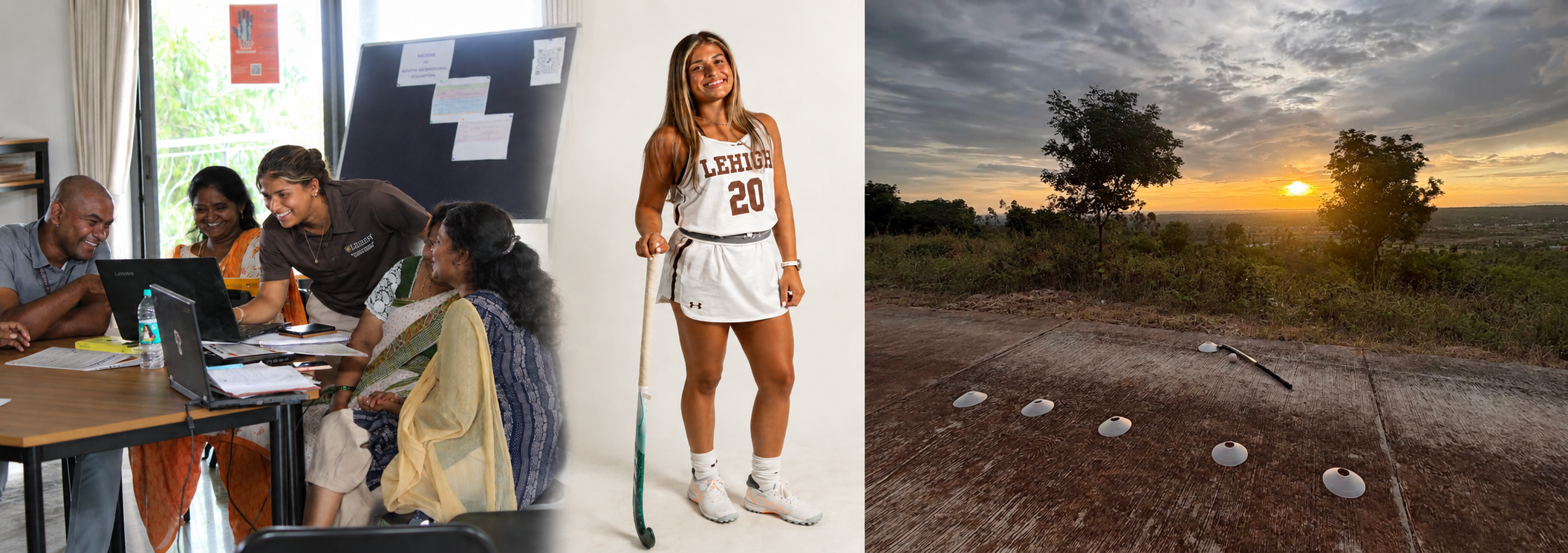
But fieldwork did not stop the countdown to field hockey season.
While working with teachers, students and partners in India, Stephenson also needed to prepare physically for preseason. She woke up early to run and even packed her field hockey stick.
Behind the residence where the team was staying, she found a paved area where she could practice stick work in the evenings.
“There was a really pretty sunset every night,” Stephenson said. “I was kind of just doing that in the background at the end of the busy days.”
She returned from India about a week before reporting for preseason.
Stephenson said years of balancing school and athletics had already taught her to work within tight windows. She maps out each week, identifying when she can study, practice and complete other commitments.
“I honestly feel like the busiest times of the year are the times that I perform the best in school,” Stephenson said. “I know when I really have to sit down and do my academic work.”
Fieldwork reinforced another familiar athletic skill: adjusting when a plan is not working.
Stephenson compared moments when the team had to rethink its approach in India to recognizing during a field hockey game that a defensive strategy is not working and changing it in real time.
“Definitely do it,” she said to student-athletes who may be interested in the Impact Fellowship program but hesitant about balancing the commitment. “There is a lot of crossover between the things that you’re doing on the field and the things that you might experience during this project.”
Julie Ammary, associate athletic director for leadership and student-athlete development, sees that connection extending well beyond competition.
“Student-athletes develop skills every day that extend well beyond competition, including discipline, time management, teamwork, resilience and the ability to adapt under pressure,” Ammary said. “Experiences like the Impact Fellowships give them another setting to apply those skills while also growing as students, leaders and professionals.”
Finding a way to make both work
Garrett Hyneman, a 2026 Global Social Impact Fellow and member of Lehigh’s cross country and track and field teams, joined PlasTech Ventures, a project working to turn discarded single-use plastic sachets in the Philippines into filament material for 3D printing.
Hyneman, who is majoring in materials science and engineering, was drawn to the project because of a longstanding interest in sustainability and the issue of plastics waste, as well as the opportunity to work on a real-world problem beyond traditional engineering courses.
He quickly discovered that the fellowship required students to take significant ownership of their projects, from reading research papers and testing materials in the lab to determining next steps with teammates and faculty mentors.
Adding those responsibilities to athletics required careful coordination. On Tuesdays, Hyneman would often leave practice on the Goodman Campus, take the bus back across South Mountain, grab dinner and head directly to the evening Impact Fellowship class.
“Balancing the schedule between athletics and the project is difficult, but it’s definitely doable,” Hyneman said.
During fieldwork in the Philippines, Hyneman and the PlasTech team explored Manila’s 3D-printing ecosystem and examined what it would take for their technology to work in the local context. The team also refined its production process, testing ways to turn sachet waste into material that could be used for 3D-printing filament.
One lesson stood out: affordability had to be central to the venture.
“I grew a deeper understanding of the importance of minimizing the cost of my venture’s product due to the nonexistent disposable income of the citizens of the Philippines,” Hyneman said.
He also found that the mental toughness developed through distance running prepared him for long days of meetings and project work.
The mental toughness that I have built as a cross country athlete helped me during fieldwork because it allowed me to work long days full of meetings with minimal sleep and lots of discipline, Hyneman said.
Ehrhardt, Stephenson and Hyneman are not alone. Other student-athletes across the Impact Fellowship program bring the same discipline and work ethic to their project teams. Olivia Dubrow ’28, a member of Lehigh’s track and field throws group and the CareAlert team, said athletics has taught her the importance of steady progress. “You need to work on the little things,” Dubrow said, a mindset she has carried into a project where students are creating solutions from the ground up. In the Philippines, cross country and track and field distance runner Siri Hellenbrand ’27 balanced training with fieldwork on MetalMatter, waking as early as 5 a.m. to run or go to the gym before joining her team by 8 a.m. for a full day of project work.
Alyssa Vandett, captain of Lehigh’s cheerleading team and a member of the Silicon Valley Social Impact Fellowship project Fostering New Futures team, said the teamwork and discipline she developed through cheerleading have also shaped how she approaches her Impact Fellowship work.
“Both experiences have taught me how to work effectively as part of a team, communicate with people in different roles, manage competing responsibilities, and step into leadership when it is needed,” Vandett said.
“That discipline, that work ethic is what I love,” Mehta said, noting how student-athletes also help keep their teams on track and moving forward.
For Creative Inquiry, those experiences point to a larger connection between athletics and impact-driven work. The same qualities that help student-athletes compete at a high level can also prepare them to contribute meaningfully to interdisciplinary teams, community partnerships and real-world problem solving.
“Student-athletes bring a unique mindset to the Impact Fellowships,” said Khanjan Mehta, vice provost for Creative Inquiry. “They know how to work toward long-term goals, adapt when conditions change, support their teammates and keep showing up when the work is hard. Those same abilities are essential in impact-driven work, where students take responsibility for real-world outcomes.”
Photo credits: Don Paul and Lafayette Athletic Communications
Lehigh Student Athletes in Impact Fellowship Program


